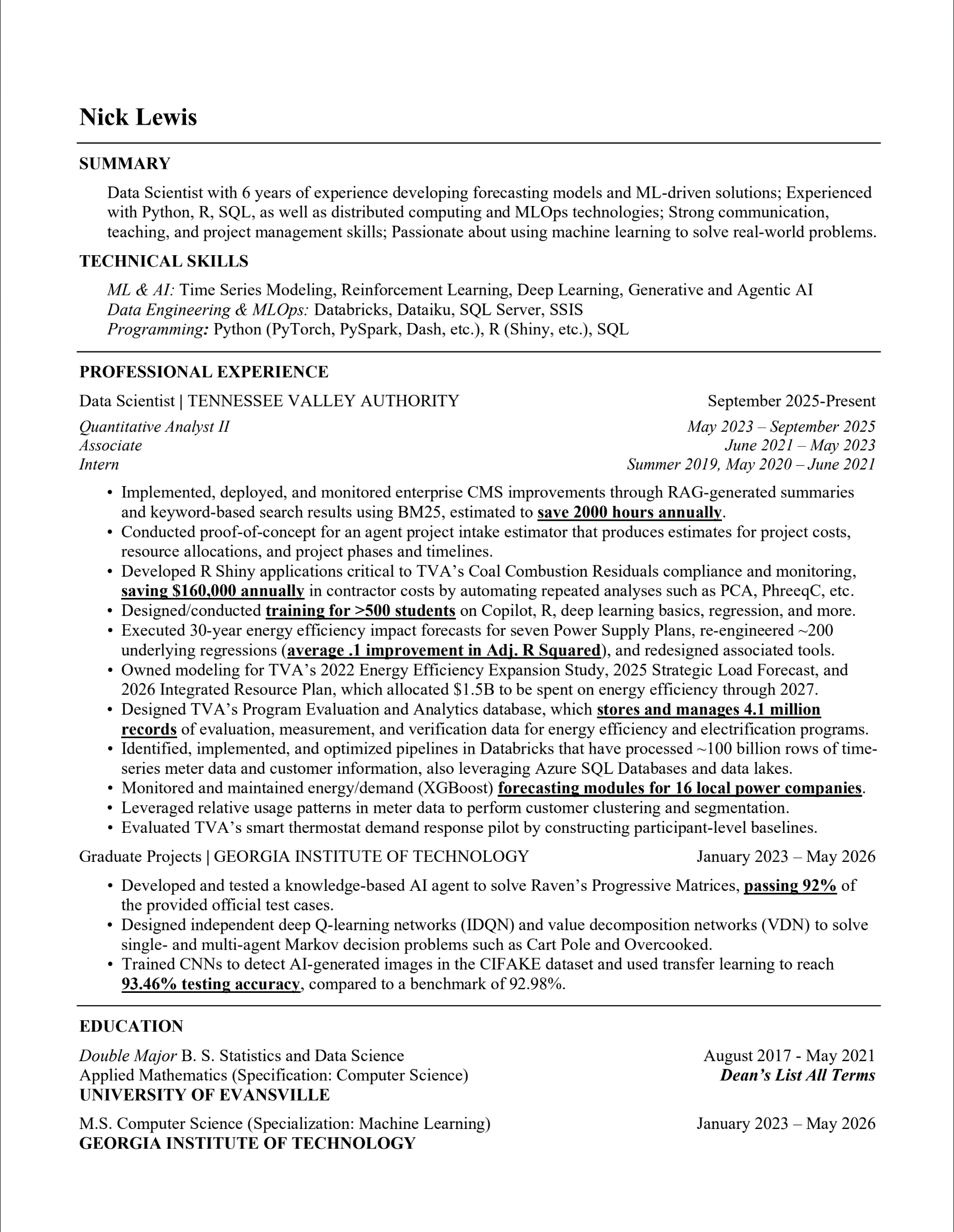
I’m a data scientist with 6 years of experience developing and delivering machine learning solutions. This includes 5 years with the Tennessee Valley Authority. I’ve recently graduated from Georgia Tech with my Master’s in Computer Science, specializing in Machine Learning.
For more questions or examples of my work, please reach out to proofthatnicklewisexists@gmail.com.
-
I have professional experience leveraging tree-based methods, neural networks, and linear models in production settings and managing MLOps pipelines. I’m a believer in the No Free Lunch theorem and that understanding the structure of a problem is essential to determining the structure of your solution.
At various points in my academic career, I’ve been able to focus in on reinforcement learning, deep learning, and computer vision.
-
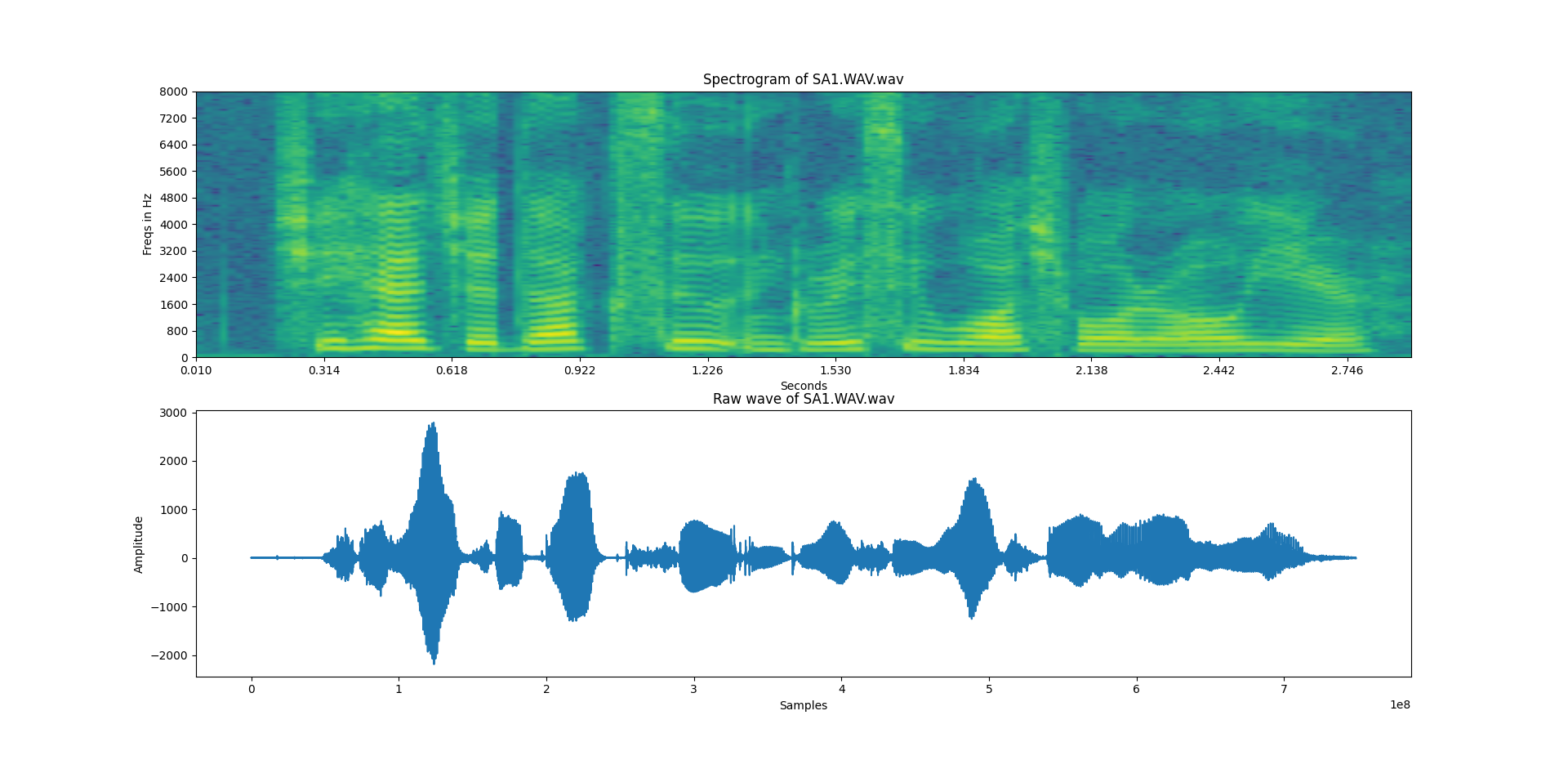
I have experience buliding custom retrieval-augmented generation (RAG) pipelines, evaluating their performance, and communicating their limitations. I approach these problems within ‘traditional’ AI patterns such as planning, meta-reasoning, and correcting mistakes.
-
I have experience in distributed, cloud computing pipelines and SQL Server database design. I’ve identified and fixed bugs, implemented upgrades and improvements, and supported new downstream analytics offerings.
-
Plenty of my work also falls into the ‘other’ category. This includes automation, data visualization, project management, R Shiny App development, various EDA, and teaching.
TECHNICAL SKILLS
Machine Learning: Time Series Modeling, Reinforcement Learning, Deep Learning, RAG Systems
Data Engineering & MLOps: Databricks, Dataiku, SQL Server, SSIS
Programming: Python (PyTorch, PySpark, Dash, etc.), R (Shiny, etc.), SQL
PROFESSIONAL EXPERIENCE
Data Scientist | TENNESSEE VALLEY AUTHORITY | September 2025-Present
Quantitative Analyst II | May 2023 – September 2025
Associate | June 2021 – May 2023
Intern | Summer 2019, May 2020 – June 2021
Implemented, deployed, and monitored enterprise CMS improvements through RAG-generated summaries and keyword-based search results using BM25, estimated to save 2000 hours annually.
Conducted proof-of-concept for an agent project intake estimator that produces estimates for project costs, resource allocations, and project phases and timelines.
Developed R Shiny applications critical to TVA’s Coal Combustion Residuals compliance and monitoring, saving $160,000 annually in contractor costs by automating repeated analyses such as PCA, PhreeqC, etc.
Designed/conducted training for >500 students on Copilot, R, deep learning basics, regression, and more.
Executed 30-year energy efficiency impact forecasts for seven Power Supply Plans, re-engineered ~200 underlying regressions (average .1 improvement in Adj. R Squared), and redesigned associated tools.
Owned modeling for TVA’s 2022 Energy Efficiency Expansion Study, 2025 Strategic Load Forecast, and 2026 Integrated Resource Plan, which allocated $1.5B to be spent on energy efficiency through 2027.
Designed TVA’s Program Evaluation and Analytics database, which stores and manages 4.1 million records of evaluation, measurement, and verification data for energy efficiency and electrification programs.
Identified, implemented, and optimized pipelines in Databricks that have processed ~100 billion rows of time-series meter data and customer information, also leveraging Azure SQL Databases and data lakes.
Monitored and maintained energy/demand (XGBoost) forecasting modules for 16 local power companies.
Leveraged relative usage patterns in meter data to perform customer clustering and segmentation.
Evaluated TVA’s smart thermostat demand response pilot by constructing participant-level baselines.
Graduate Projects | GEORGIA INSTITUTE OF TECHNOLOGY | January 2023 – March 2024
Developed and tested a knowledge-based AI agent to solve Raven’s Progressive Matrices, passing 92% of the provided official test cases.
Designed independent deep Q-learning networks (IDQN) and value decomposition networks (VDN) to solve single- and multi-agent Markov decision problems such as Cart Pole and Overcooked.
Trained CNNs to detect AI-generated images in the CIFAKE dataset and used transfer learning to reach 93.46% testing accuracy, compared to a benchmark of 92.98%.


EDUCATION

University of Evansville
B.S. in Stat. and Data Science and Applied Math
(Specification: Computer Science)
2017 - 2021

Georgia Institure of Technology
M.S. in Computer Science
(Specialization: Machine Learning)
2023 - 2026